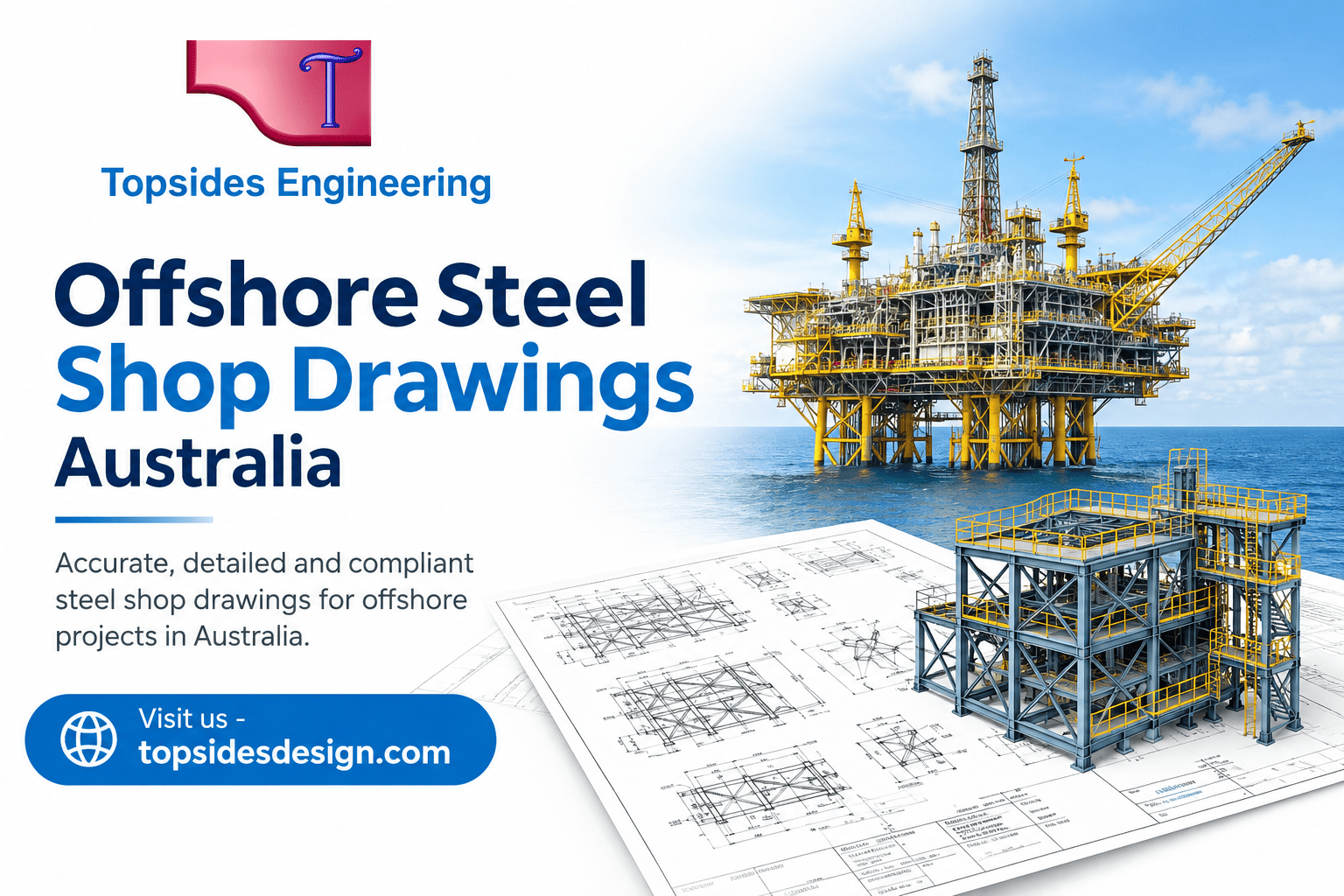
Offshore Steel Fabrication Detailing and Shop Drawing Standards in Australia
Offshore steel structures demand precision, careful planning, and reliable fabrication information. Unlike standard construction projects, offshore facilities operate in demanding marine environments. Steel components must withstand wind, waves, corrosion, vibration, heavy equipment, and complex installation conditions. This makes accurate detailing an essential part of project delivery.
Australian offshore projects also need to follow applicable structural, fabrication, welding, and project-specific requirements. Detailed offshore steel shop drawings Australia help fabricators understand exactly how each component should be manufactured and assembled. They also support engineers, contractors, and installation teams throughout the project lifecycle. Modern 3D modeling platforms have further improved this process by allowing teams to coordinate complex steel structures before fabrication begins.
From primary framing and structural connections to platforms and decks, every element requires careful coordination. This article explores the key considerations for offshore steel detailing and shop drawings in Australia, including standards, digital workflows, connection detailing, quality checks, and fabrication requirements.
The Role of Steel Detailing in Offshore Projects
Offshore steel shop drawings Australia convert engineering designs into practical fabrication and erection information. It provides the dimensions, materials, connections, welds, bolts, member marks, and assembly information needed by fabrication teams.
For offshore structures, accuracy becomes particularly important because correcting steelwork after fabrication can be expensive and difficult. Components may need to travel long distances before reaching an offshore facility. Therefore, potential clashes and detailing issues should be identified as early as possible.
Experienced providers of structural steel detailing services Australia can help create coordinated models and drawings that support fabrication while maintaining the original engineering intent.
Australian Standards and Project Requirements
Offshore steel projects can involve several Australian and international standards. The applicable requirements depend on the project scope, structural system, location, and client specifications.
AS 4100 is commonly associated with structural steel design, while AS/NZS 5131 addresses structural steelwork fabrication and erection. Welding may also need to follow relevant AS/NZS 1554 requirements.
However, standards alone do not define every detailing requirement. Project specifications, engineering drawings, fabrication procedures, and client requirements must also be considered.
What Offshore Fabrication Drawings Should Show
Fabrication drawings should communicate information clearly enough for workshop teams to manufacture components without unnecessary interpretation.
Typical offshore steel fabrication drawings information includes:
- Member sizes and material grades
- Plate dimensions and thicknesses
- Connection details
- Bolt sizes and locations
- Weld specifications
- Assembly and part marks
- Overall dimensions
- Relevant fabrication notes
Consistency is equally important. Member marks, revisions, dimensions, and references should remain coordinated between drawings and the 3D model.
Well-prepared structural steel shop drawing services can therefore improve fabrication accuracy while reducing confusion during assembly.
Offshore Deck Detailing Considerations
Offshore decks often combine structural framing with equipment, piping supports, grating, walkways, handrails, and access systems. This creates a dense working environment where small coordination issues can affect several disciplines.
Effective offshore deck fabrication detailing helps ensure that structural members accommodate these requirements without compromising the approved design.
Deck detailing should consider:
- Framing arrangements
- Equipment supports
- Openings and penetrations
- Grating and plate interfaces
- Stiffeners
- Access requirements
- Connection locations
Early coordination can significantly reduce the possibility of fabrication or installation conflicts.
Tekla-Based Offshore Steel Detailing, Fabrication Drawings, Structural Connections, and Deck Detailing
Tekla Structures supports detailed 3D modeling and fabrication documentation for complex steel structures. A coordinated model can provide a common reference for members, plates, connections, assemblies, and drawings.
With Tekla offshore steel detailing, detailers can examine complicated structural arrangements and identify potential clashes before fabrication. The model can also support the production of fabrication drawings, material information, assembly details, and other project deliverables.
However, software is only part of the process. Skilled detailing professionals must understand fabrication methods, structural requirements, connection behavior, and project standards to produce reliable outputs.
Quality Checks Before Fabrication
Quality control should take place before drawings reach the fabrication floor. A structured checking process can identify errors while changes are still relatively easy to make.
Important checks include dimensions, member sizes, material grades, connection geometry, welds, bolts, assembly marks, drawing revisions, and model-to-drawing consistency.
Clash detection is particularly valuable for offshore steel shop drawings Australia because structural steel often interfaces with mechanical, electrical, piping, and equipment systems.
Why Precision Matters in Offshore Deck Fabrication
Clear deck documentation helps fabricators understand how individual components fit together. It can also support material tracking, inspection, assembly, and installation.
Accurate offshore deck shop drawings should maintain clear references between general arrangements, assemblies, and individual parts. Consistent numbering and readable dimensions make workshop interpretation easier.
When combined with a coordinated 3D model, these drawings provide a stronger link between engineering, fabrication, and offshore installation.
Final Note
Successful offshore steel shop drawings Australia depend on accurate detailing, coordinated drawings, careful connection design, and effective quality control. Australian projects require these processes to work alongside applicable standards and project-specific requirements.
For organizations seeking specialist support with offshore steel modeling, fabrication documentation, structural connections, and deck detailing, they can trust us at Topsides Engineering. Our technical expertise can help project teams develop coordinated models and fabrication-ready drawings for demanding offshore applications. To learn more about our curated solutions, visit our website now.