Australian Structural Steel Detailing: From Tekla 3D Modelling to Fabrication-Ready Shop Drawings
A structural steel detailing workflow Australia plays a vital role in turning engineering designs into accurate, buildable steel structures. Fabricators across this region rely on detailed drawings and coordinated 3D models to reduce errors and support efficient workshop production. From commercial buildings and industrial facilities to complex offshore structures, every steel component must be clearly defined before fabrication begins.
Modern detailing platforms such as Tekla Structures help detailers create precise models, coordinate connections, and produce detailed drawings from a single project environment. This approach improves communication between engineers, detailers, fabricators, and site teams. It also helps identify clashes and constructability issues before steel reaches the workshop.
As project requirements become more demanding, accurate detailing has become an essential part of Australia’s structural steel fabrication process. Understanding the workflow from 3D modelling to shop drawings can help project teams achieve better accuracy, coordination, and fabrication outcomes.
The Role of Tekla 3D Modelling in Steel Detailing
A detailed 3D model provides a central source of information for structural steel projects. It represents beams, columns, braces, plates, bolts, welds, and other components within a coordinated digital environment.
Tekla 3D modelling for steel fabrication allows detailers to develop steel structures based on engineering information while considering fabrication and erection requirements. The model can include member profiles, material grades, connection components, dimensions, and other manufacturing information.
One major advantage is improved coordination. Detailers can review the relationship between steel members and identify potential clashes before fabrication. This can reduce costly changes during workshop production or site installation.
The model also supports the generation of drawings and fabrication information. When changes are made correctly within the model, related documentation can be updated more efficiently. This creates a more connected workflow from design development to fabrication.
Steel Detailing Workflow for Fabrication, Connection Detailing, Shop Drawings, and Offshore Deck Structures
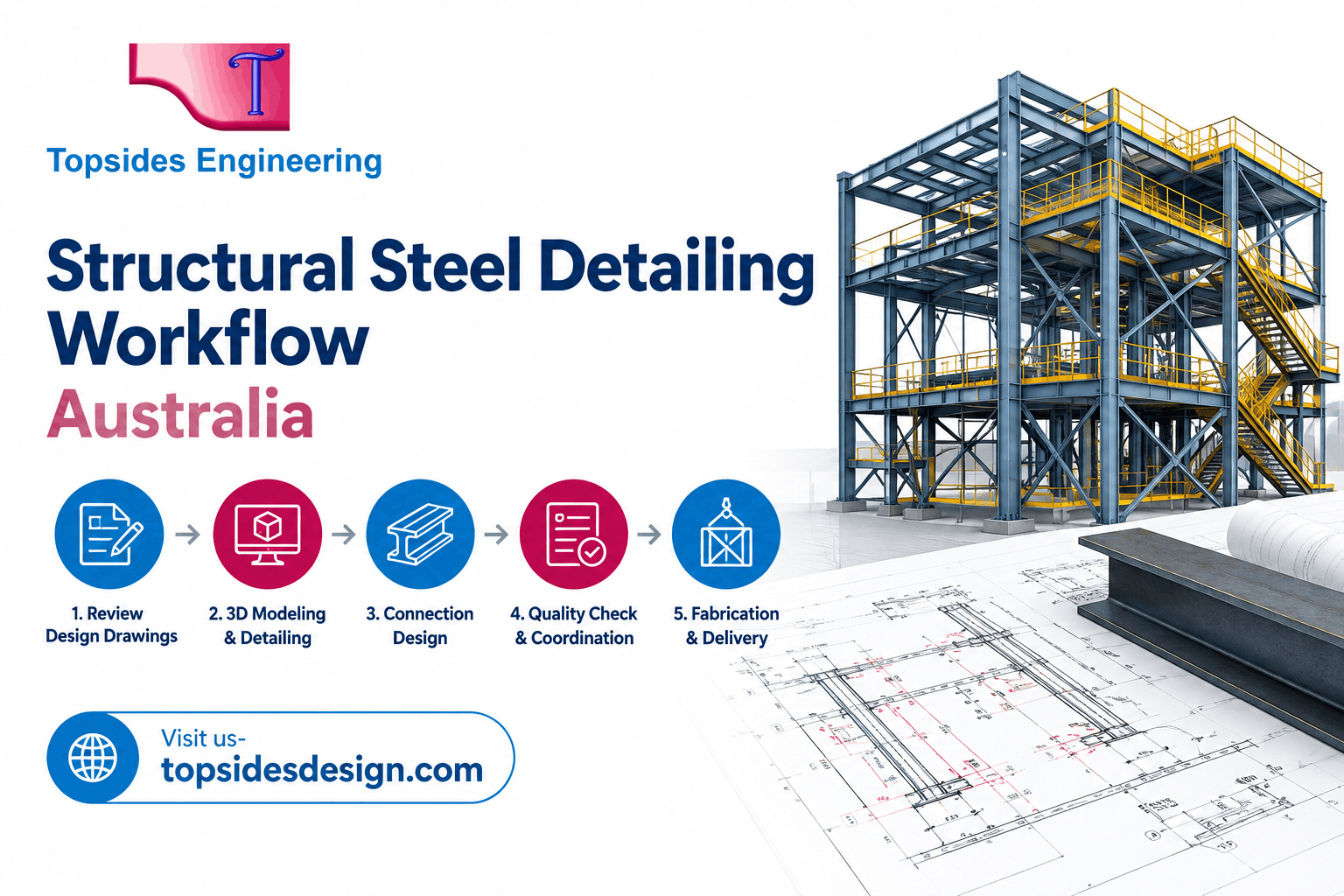
A structural steel detailing workflow Australia helps fabricators receive clear and usable project information. Although individual projects may have different requirements, the process generally follows several important stages.
Reviewing Engineering Documentation
The detailing process begins with a thorough review of structural drawings, specifications, design models, architectural information, and relevant project requirements. Detailers examine member sizes, structural layouts, levels, materials, connection concepts, and fabrication requirements.
Any inconsistencies should be identified early and communicated to the appropriate project stakeholders. This review creates a reliable foundation for developing the fabrication model.
Developing the 3D Structural Model
After reviewing the available information, detailers develop the structural steel model. Each member must be positioned accurately according to the approved engineering information.
The Tekla steel detailing and fabrication drawings model may include primary steelwork, secondary framing, plates, stiffeners, bolts, welds, brackets, and connection components. Accurate modelling at this stage helps maintain consistency throughout the project.
Experienced detailers also consider how individual components will be fabricated, transported, assembled, and erected.
Connection Detailing
Connections are among the most important elements of structural steel detailing. They determine how individual members interact and transfer structural forces.
Structural steel connection detailing and shop drawings must clearly communicate connection geometry, bolt arrangements, weld requirements, plates, stiffeners, and relevant dimensions.
Connection details should align with engineering requirements while remaining practical for fabrication and installation. Proper coordination can also reduce uncertainty for workshop teams and site crews.
Generating Fabrication Drawings
Once the model has been reviewed and coordinated, detailers produce drawings required for fabrication. These may include general arrangement drawings, assembly drawings, single-part drawings, and other project-specific documentation.
Fabrication-ready structural steel shop drawings provide the practical information needed by fabricators to manufacture individual steel components and assemblies accurately.
Drawings should present dimensions, material information, marks, connection details, weld information, bolt details, and other relevant manufacturing data. Clear drawing presentation helps workshop teams interpret information without unnecessary clarification.
Technical Requirements for Offshore Structural Steel Detailing
Offshore projects introduce additional complexity because steel structures may operate in demanding marine environments. Components can include platforms, walkways, support frames, stairs, handrails, equipment supports, and deck structures.
Offshore structural steel detailing and fabrication requires careful attention to geometry, connections, access, constructability, and assembly requirements.
Offshore structures often involve numerous interfaces with mechanical, piping, electrical, and equipment systems. A coordinated model can help detailers identify spatial conflicts before fabrication.
Transport and installation requirements should also influence detailing decisions. Large assemblies may require practical lifting points, manageable fabrication units, and suitable erection sequences.
Detailed Steelwork for Offshore Deck Structures and Fabrication
Deck structures require particular attention because they often support equipment, personnel, piping, and operational systems. Their detailing must account for structural framing as well as the interfaces surrounding the deck.
Offshore deck structural detailing and shop drawings can include beams, plates, stiffeners, deck supports, penetrations, brackets, access components, and connection details.
Clear documentation helps fabrication teams understand how individual components fit together. It can also support better planning for welding, assembly, transportation, and offshore installation.
A coordinated model is especially useful when deck structures contain dense steelwork and numerous connection points. Early clash detection can prevent fabrication issues that may otherwise become expensive to resolve later.
Key Steel Detailing Deliverables
Every project can have different documentation requirements. However, common deliverables may include general arrangement drawings, assembly drawings, single-part drawings, material lists, bolt lists, and model files.
The steel detailing deliverables for Australian fabricators should be organized according to project requirements and presented in a format that supports practical workshop use.
Quality checks should take place before drawings are issued. These checks can cover dimensions, member orientations, connection information, material specifications, drawing references, part marks, and model coordination.
A structural steel detailing workflow Australia helps reduce avoidable errors and supports smoother fabrication.
Final Note
A well-planned structural steel detailing workflow Australia helps project teams move efficiently from engineering designs to accurate fabrication and installation. Tekla 3D modelling, precise connection detailing, coordinated shop drawings, and thorough quality checks all contribute to better project outcomes. These practices become even more important for complex offshore structures, where accuracy and coordination can directly affect fabrication and installation.
For reliable support with structural and offshore steel detailing, an organization can rely on us at Topsides Engineering. We offer professional modelling and detailing solutions tailored to project requirements. Visit our website now to explore our structural steel detailing and fabrication capabilities.