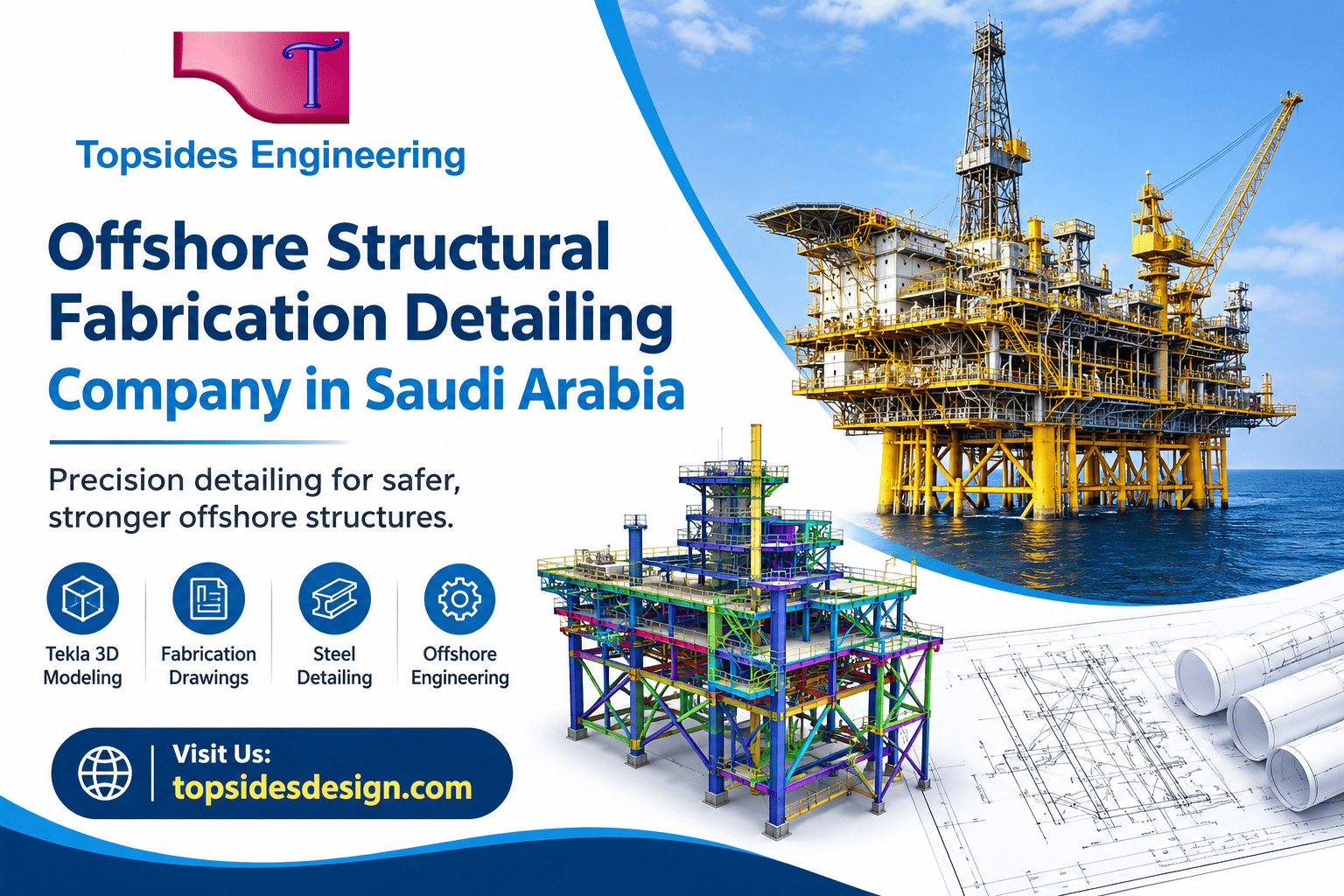
How an Offshore Structural Fabrication Detailing Company in Saudi Arabia Improves Project Accuracy
Offshore structural projects demand precision at every stage. A small error in a drawing can affect fabrication, assembly, materials, and installation. These issues can become costly when structures are large, complex, and difficult to modify after fabrication. This is why accurate detailing plays an important role in offshore construction.
An offshore structural fabrication detailing company in Saudi Arabia helps convert engineering designs into practical fabrication information. This information can include detailed drawings, 3D models, connection details, material lists, and assembly documentation. These deliverables help fabrication teams understand exactly how structural components should be produced and assembled.
Modern detailing also supports better coordination between engineers, fabricators, contractors, and project managers. Advanced 3D modeling can help teams identify potential clashes before fabrication begins. This approach can reduce uncertainty and support smoother project execution. In this blog, we will explore how accurate detailing, 3D modeling, fabrication drawings, material planning, and connection detailing can improve offshore project accuracy.
Why Accuracy Matters in Offshore Structural Projects
Offshore structures must meet demanding engineering and fabrication requirements. Projects may involve jackets, topsides, decks, floating platforms, rigs, and other complex steel systems. Each component needs accurate information before fabrication begins. Incorrect dimensions or unclear connection details can create problems later.
An offshore structural fabrication detailing company in Saudi Arabia can improve accuracy by developing detailed documentation based on approved engineering information.
Accurate detailing can help with:
- Correct member dimensions
- Clear connection information
- Accurate material quantities
- Proper weld locations
- Better assembly planning
- Consistent fabrication drawings
- Improved coordination between project teams
These details create a stronger connection between engineering design and physical fabrication.
How 3D Modeling Improves Detailing Accuracy
3D modeling has become an important part of modern offshore structural detailing. It gives engineers and fabricators a clear digital view of the structure before physical work begins. This helps teams review design details, coordinate different components, and identify possible issues earlier. As a result, 3D modeling can support better detailing accuracy and smoother fabrication workflows.
Creating a Clear Digital Representation
Modern offshore detailing often uses 3D modeling to represent structural components digitally. A detailed model allows project teams to examine the structure before fabrication starts. The model can show structural members, plates, connections, supports, and other components in their correct relationships. This makes it easier to identify potential problems at an earlier stage.
A digital model also provides a common reference for engineers, detailers, fabricators, and other project teams. Everyone can review the same structural information and understand how individual components fit together. This can reduce confusion and improve communication during the detailing process.
Detecting Clashes Before Fabrication
Clash detection is another important benefit of 3D modeling. Offshore structures can contain many components within limited spaces. Potential conflicts may occur between structural members, equipment supports, piping systems, access structures, platforms, walkways, plates, and connections.
Finding these issues digitally can be easier than correcting them after fabrication. Teams can review the model, identify areas of interference, and make necessary adjustments before components reach the fabrication stage. This approach can help reduce rework and support better fabrication readiness.
Reducing Rework and Fabrication Errors
Rework can consume time, materials, labor, and workshop capacity. Accurate detailing helps identify issues before fabrication begins. Clear structural steel fabrication drawing services in Saudi Arabia give teams reliable information about dimensions, connections, and component placement.
For example, detailed modeling can reveal:
- Incorrect member placement
- Connection conflicts
- Dimensional inconsistencies
- Limited welding access
- Assembly difficulties
- Component interference
Early identification allows teams to resolve problems before they reach the fabrication floor. This can reduce material changes, delays, and unnecessary labor. Consistent documentation also helps fabrication teams identify components and understand how they fit into larger assemblies. Overall, accurate detailing supports smoother workshop coordination and helps reduce avoidable fabrication errors.
Supporting Material Planning
Accuracy is not limited to drawings. Material information is also important for offshore structural fabrication. Detailed material take-offs help project teams understand the types and quantities of materials required for fabrication. Cutting lists and plate nesting can further improve material utilization and support better planning.
These practices are also relevant to structural steel fabrication drawing services in Qatar, where accurate material information can support organized fabrication workflows. Accurate material data helps teams plan procurement, track structural materials, prepare cutting information, reduce unnecessary waste, coordinate fabrication activities, and improve production planning. Together, material take-offs, cutting lists, and plate nesting can support a more organized and efficient structural fabrication workflow.
Improving Connection Detailing
Connections are critical parts of offshore steel structures. Bolted and welded connections must be represented accurately so fabricators understand how structural members should come together.
Connection detailing can help clarify:
- Plate arrangements
- Bolt locations
- Weld information
- Stiffeners
- Connection dimensions
- Member interfaces
Clear connection information can reduce uncertainty during fabrication and assembly. For complex offshore structures, connection coordination also needs to work with the overall structural model. This helps maintain consistency across different project deliverables.
Supporting Complex Offshore Structures
Offshore detailing requirements vary depending on the type of structure. Projects can involve jackets, topsides, fixed platforms, floating platforms, jack-up vessels, rigs, barges, and liftboats. Offshore renewable structures can also require detailed steel modeling and fabrication documentation.
Each structure can have different requirements for connections, assemblies, materials, access, and fabrication. A structured detailing process helps address these requirements while keeping documentation coordinated.
Choosing the Right Detailing Approach
When selecting an offshore structural fabrication detailing company in Qatar, project teams should consider several factors.
Important areas include:
- Experience with offshore structures
- 3D modeling capabilities
- Fabrication drawing expertise
- Connection detailing knowledge
- Material take-off capabilities
- Quality control processes
- Revision management
- Understanding of fabrication workflows
- Ability to coordinate complex structural information
A strong detailing workflow should focus not only on producing drawings but also on making those drawings practical for fabrication and assembly.
Conclusion
Accuracy is one of the foundations of successful offshore structural fabrication. Detailed drawings, coordinated 3D models, accurate material information, and clear connection details can help reduce errors before they reach the fabrication stage. They can also support better communication, material planning, assembly, and project coordination.
For companies seeking an offshore structural fabrication detailing company in Saudi Arabia, they can rely on us at Topsides Engineering. We provide structural and marine engineering capabilities covering 3D Tekla modeling, fabrication detailing, weld modeling, material take-offs, connection design, and other offshore structures. To learn more about our curated solutions, visit our website today.