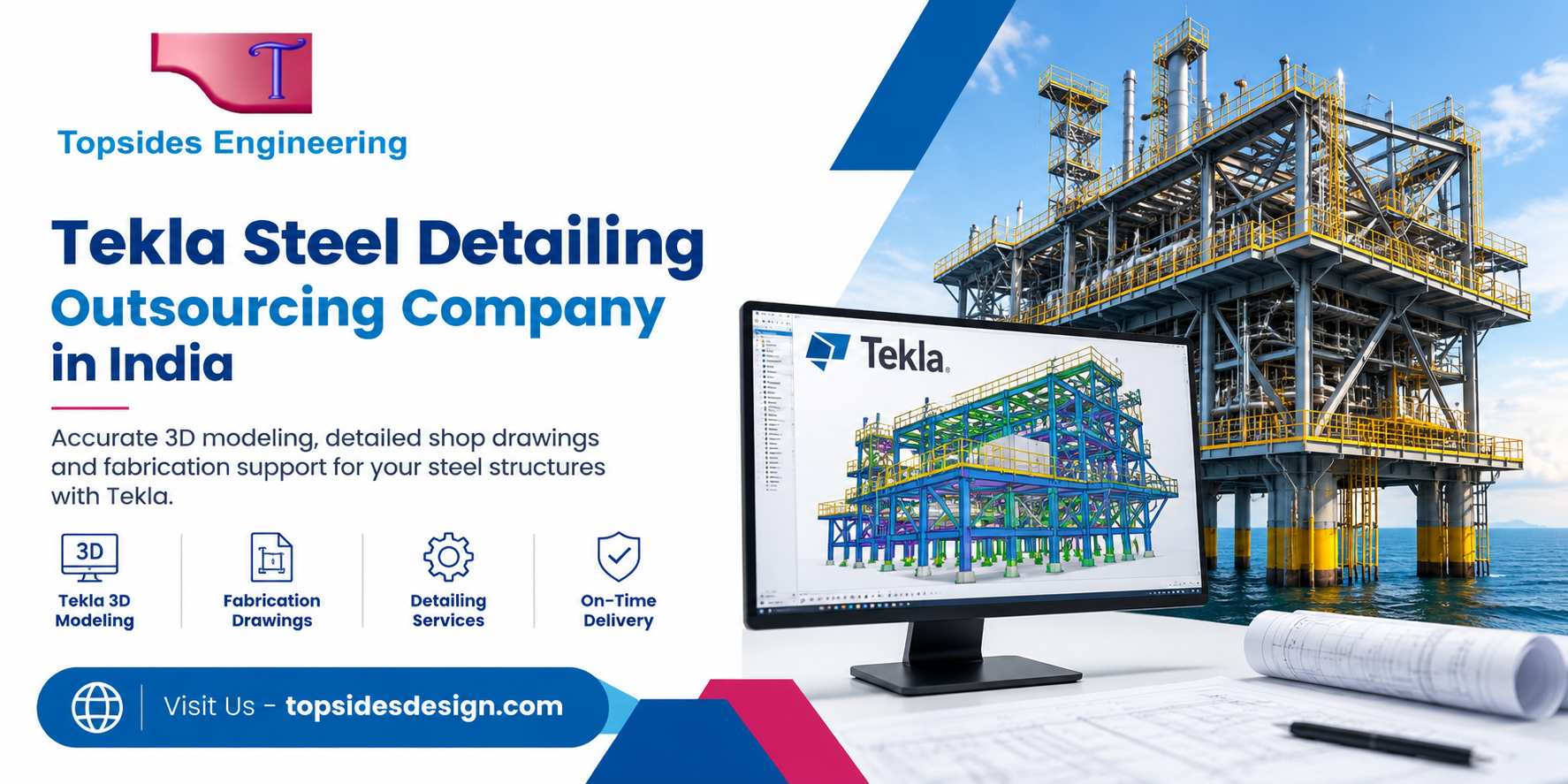
Tekla Steel Detailing Outsourcing: Precision, Coordination and Project Efficiency
Structural steel projects depend on accurate detailing to translate engineering intent into fabrication-ready information. As structures become more complex, digital modelling and coordinated drawings have become essential for reducing ambiguity, controlling fabrication risks, and keeping construction workflows efficient.
Choosing a Tekla steel detailing outsourcing company in India can provide access to specialised modelling expertise while helping project teams manage workloads, schedules, and documentation requirements.
Here, the guide explores how modern steel detailing supports fabrication, coordination, quality control, cost management, and smoother project execution.
Turning Engineering Intent into Buildable Information
A structural design becomes useful on the construction floor only when its requirements can be interpreted accurately by fabricators, contractors, and erection teams. Steel detailing serves as the bridge between engineering concepts and physical components by translating structural information into precise digital models and drawings.
Tekla-based modelling can represent beams, columns, braces, connections, plates, bolts, and other components within a coordinated three-dimensional environment. This approach makes it easier to examine how individual elements interact before fabrication begins. Potential clashes, unclear connections, dimensional inconsistencies, and coordination issues can therefore be identified earlier instead of becoming expensive site problems.
The value of detailing extends beyond drawing production. A well-developed model creates a structured source of information that can support fabrication planning, material estimation, assembly sequencing, and communication between different project stakeholders. This makes digital detailing an important part of modern structural project delivery.
Building Better Coordination through Digital Steel Models
Complex steel structures rarely exist in isolation. Structural members often need to coordinate with architectural elements, mechanical systems, piping, electrical services, foundations, equipment, and existing structures. A detailed three-dimensional model provides a shared visual environment where these relationships can be examined more effectively.
For international projects, offshore structural detailing outsourcing services India can also support demanding structural requirements where multiple disciplines and stringent project specifications must work together. Offshore facilities, industrial structures, infrastructure, and heavy steel applications may require careful attention to geometry, connections, constructability, and project-specific standards.
Digital coordination also improves communication between geographically distributed teams. Instead of relying solely on two-dimensional interpretations, stakeholders can review model information and understand how structural elements fit together. This can reduce misunderstandings and create a clearer workflow from engineering approval to fabrication and erection.
Making Fabrication Drawings More Reliable and Practical
Fabrication drawings are among the most important deliverables in the structural steel workflow because they provide the information needed to manufacture individual components and assemblies. Their accuracy directly influences shop productivity, material utilisation, fabrication time, and erection efficiency.
When organisations consider structural steel fabrication drawing outsourcing in India, the objective should not simply be to transfer drawing production to an external team. The process should create a dependable extension of the project workflow, with clear communication, consistent documentation, and strong attention to engineering intent.
Detailed drawings can communicate dimensions, material specifications, connection information, weld requirements, bolt arrangements, part marks, and assembly relationships. When these details are properly coordinated with the underlying model, fabricators can work with greater confidence and fewer clarification requests.
The real advantage comes from creating a connected workflow in which modelling and drawing production reinforce each other. Changes can be assessed within the digital environment, coordinated information can be updated, and downstream documentation can reflect approved project requirements more consistently.
Improving Shop Readiness through Connected Documentation
The transition from a digital structural model to the fabrication shop involves more than exporting drawings. Every component needs to carry the right information so that fabrication teams can understand what must be produced, how parts relate to assemblies, and how the completed structure will eventually be erected.
This is where a shop drawing outsourcing & detailing company in India can contribute to a more organised documentation process. Properly coordinated shop drawings can help fabricators interpret individual components while supporting the broader assembly and erection sequence.
A connected detailing approach can also improve traceability. Part marks, assembly information, revisions, and drawing references can be managed within an organised documentation framework. When revisions occur, maintaining consistency between model data and drawings becomes particularly important because outdated information can create confusion across fabrication and site teams.
For projects involving large quantities of repetitive or customised steel members, systematic documentation can also make production planning more predictable. The result is a workflow where drawings function not merely as technical documents but as practical instructions for turning digital information into physical steel.
Reducing Rework through Early Clash Detection
Rework is often expensive because its impact extends beyond the correction itself. A detailing error can influence material procurement, fabrication schedules, transportation, site erection, labour allocation, and project milestones. Detecting potential issues before fabrication therefore creates significant value.
Three-dimensional Tekla modelling provides an opportunity to review structural relationships before components reach the workshop. Intersections between members, unusual connection conditions, access limitations, dimensional conflicts, and coordination problems can be evaluated digitally.
This preventive approach changes the role of detailing from documentation to risk management. Instead of waiting for a fabrication or erection problem to reveal an inconsistency, project teams can investigate the digital model and resolve issues earlier.
Quality control also becomes more structured when modelling and drawing workflows are supported by defined review procedures. Checking dimensions, connections, member information, drawing consistency, revisions, and project requirements can help improve the reliability of final deliverables.
Creating Scalable Workflows for Global Steel Projects
Steel detailing requirements can vary significantly according to project type, structural complexity, location, applicable standards, fabrication practices, and client expectations. A scalable outsourcing model therefore needs to accommodate changing workloads without compromising consistency.
For engineering and fabrication organisations managing multiple projects, outsourcing can provide additional technical capacity during periods of high demand. It can also allow internal teams to concentrate on engineering decisions, project management, client coordination, and other activities while specialised detailing work progresses in parallel.
A strong workflow depends on more than software proficiency. Communication protocols, clearly defined inputs, revision management, quality checks, delivery schedules, and coordination procedures all contribute to dependable outcomes. The ability to adapt these processes to different project requirements is especially important for international work.
Modern detailing is also increasingly connected with broader digital construction practices. As structural projects move toward more data-driven workflows, models can become valuable sources of information throughout fabrication, logistics, assembly, and project coordination. This makes accurate detailing an investment in the wider digital lifecycle of a structure rather than a standalone drafting activity.
Conclusion: Precision that Connects Design with Fabrication
Accurate steel detailing brings together engineering intent, digital modelling, fabrication requirements, and construction coordination in one connected workflow. From clash detection and shop documentation to revision control and fabrication readiness, each stage can influence the efficiency and reliability of the final structure.
Working with a Tekla steel detailing outsourcing company in India can help organisations access specialised capabilities while creating a more scalable approach to demanding structural projects. For precise Tekla modelling, fabrication detailing, and engineering support tailored to complex project requirements, connect with Topsides Engineering today.